10 Tips for Sourcing LED Drone Lights Worldwide
Sourcing a reliable Led Drone Light worldwide requires more than comparing prices on a supplier website. Buyers must examine brightness, battery endurance, heat control, mounting strength, and production consistency. A light may look impressive in a product photo, yet perform poorly above a windy stadium.
Dr. Elena Marquez, an aerial-lighting systems consultant, explains, “A dependable Led Drone Light is judged in the sky, not inside a catalog.” Her observation captures a common sourcing mistake: specifications often hide practical weaknesses. Ask for photometric data, waterproofing details, sample units, and documented quality checks. Then test the lights during night flights, transport, charging, and repeated installation.
Supplier experience matters. Confirm factory capacity, component origins, inspection procedures, packaging protection, and replacement policies. Request videos showing real flight performance, not only computer-generated displays. Check whether the manufacturer can maintain identical color temperature across hundreds of units. Small differences become visible during coordinated formations.
International sourcing also demands careful communication. Clarify plug standards, battery shipping arrangements, lead times, labeling, warranty terms, and responsible drone-operation requirements. Work with suppliers that support safe, lawful use in the destination market. Never treat compliance as an afterthought.
There is room for doubt.
Even experienced buyers can miss hidden costs, delayed samples, or unstable battery cells. I have found that a lower quotation sometimes creates higher testing expenses later. This guide presents ten practical tips for comparing global suppliers, reducing avoidable risks, and selecting a Led Drone Light system that performs reliably beyond the sales demonstration.
Define Performance Requirements for LED Drone Lights
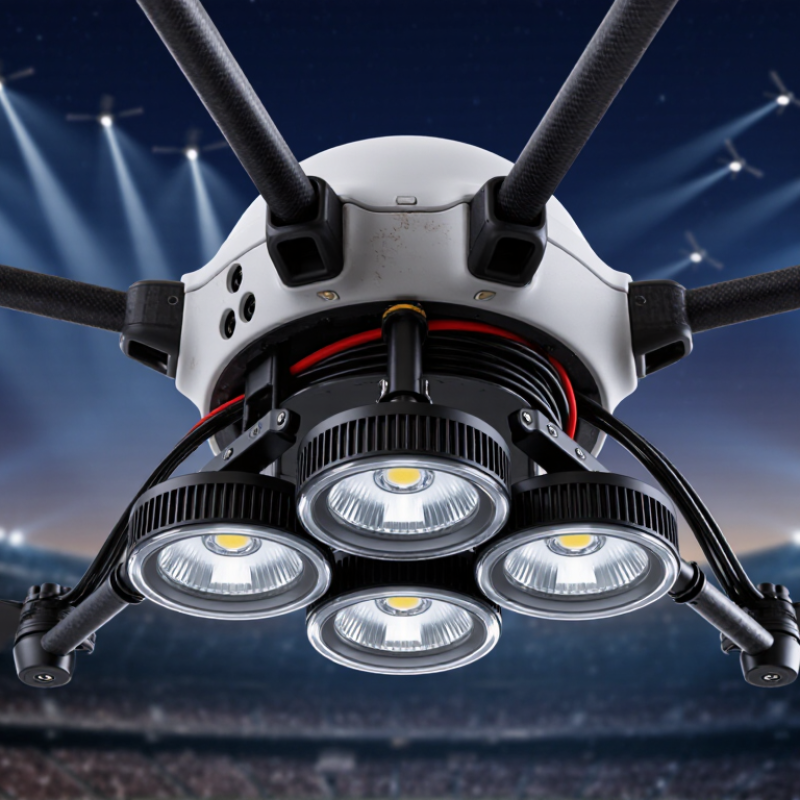
When sourcing LED drone lights worldwide, begin with a measurable performance brief. State the required luminous output in lumens, not “very bright.” Define beam angle, color temperature, color rendering, and acceptable variation. A narrow beam can illuminate a landing area, while a wider beam supports search visibility. These purposes are different. Specify mounting weight and center of gravity. Even a small imbalance can shorten flight time or affect stability.
Set operating targets for runtime, battery voltage, heat, and environmental protection. Ask whether output must remain stable after twenty minutes, not only during a fresh-battery demonstration. Record the intended altitude, air temperature, and airflow. These details expose weak assumptions. In field tests, measure light at the working distance with a calibrated meter when possible. Camera footage alone can mislead.
Require samples, test reports, wiring diagrams, control protocols, and a clear tolerance table. Check flicker, startup delay, dimming steps, connector security, and emergency shutoff behavior. Keep a simple acceptance checklist. Our early specifications once ignored glare near reflective surfaces; that omission caused retesting. A practical brief should include failure conditions, replacement parts, and inspection records. Leave room for revision, because real flight data may challenge the original numbers.
Compare Global Suppliers and Manufacturing Capabilities
Sourcing LED drone lights worldwide requires more than comparing unit prices. Compare suppliers by manufacturing depth, not polished websites. Check whether they design optics, assemble circuit boards, and test finished lights in-house. A factory with controlled production usually offers better consistency than a trading company. Ask for lumen reports, beam angles, operating temperatures, and IP test records. Clear technical evidence builds trust.
Tip: Request samples from three regions before choosing a supplier. Examine brightness, heat management, charging stability, and mounting strength. A small workshop test can reveal uneven illumination or loose connectors. Compare minimum order quantities, tooling costs, production capacity, and lead times together. A low quotation may hide expensive molds or slow replacement support. I have seen attractive samples fail after repeated vibration testing. That is easy to miss.
Tip: Audit quality systems remotely or on site. Review incoming-material checks, assembly records, aging tests, and final inspections. Ask how suppliers handle failed units and corrective actions. Manufacturing capabilities can differ sharply between pilot batches and mass production. Confirm whether the same LEDs, drivers, lenses, and housings remain available later. Local service partners may reduce delays, but their technical skill needs verification. Leave room for doubt. A supplier’s confident answer is not proof. Supplier comparison should remain evidence-based, documented, and practical.
Global LED Drone Light Sourcing Benchmark
Typical non-brand supplier benchmarks for comparing manufacturing capability, order flexibility, and delivery speed across major sourcing regions.
East and Southeast Asia generally offer the highest production capacity and lower minimum order quantities, while suppliers in Europe and North America typically provide shorter regional delivery routes and stronger proximity to local compliance support. Actual lead times, MOQs, and capacity vary by product specification, battery configuration, optical design, and certification requirements.
Verify Product Quality, Certifications, and Safety Standards
When sourcing LED drone lights worldwide, verify the product before negotiating price. Ask for a current specification sheet, sample unit, and production photos. Check brightness, beam angle, color temperature, battery life, and heat performance. A light that looks powerful on a workbench may overheat during flight. Test the light.
Request certification documents from an accredited laboratory, not only a supplier-made declaration. Confirm the report matches the exact model, input voltage, battery type, and housing design. Review relevant electrical, electromagnetic compatibility, and environmental safety standards for the destination market. An IP rating should reflect real sealing tests, not a printed claim. Certification scope matters. Dates matter too.
Inspect samples under vibration, rain simulation, repeated charging, and continuous operation. Look for loose connectors, flickering LEDs, sharp edges, and swelling batteries. Ask how each batch is traced, tested, and packed. I have seen attractive samples differ from later production units, so approve a sealed reference sample. This step feels slow, but it prevents expensive surprises. Confirm local aviation and transport requirements with qualified professionals before shipment. Rules can vary by country and application. A certificate alone does not prove reliable field performance. Supplier answers should be specific, documented, and consistent. If anything remains unclear, pause the order and request another test.
Evaluate Pricing, Shipping Terms, and Import Requirements
Sourcing LED drone lights worldwide requires more than comparing unit prices. Request a landed-cost quotation, not only an FOB or EXW price. Include tooling, inspection, packaging, insurance, freight, customs duty, and local taxes. The World Bank’s Logistics Performance Index 2023 assessed 139 economies and showed major differences in clearance speed and delivery reliability. Location matters.
Ask suppliers to state Incoterms 2020, shipment weight, carton dimensions, and quote validity. Air freight may suit urgent samples, but dimensional weight can surprise buyers. Sea freight lowers transport cost for larger orders, yet port handling and delays add risk. If the lights contain lithium batteries, request the applicable transport test summary and packaging evidence before booking. Small details matter.
Import preparation needs equal attention. Confirm the likely HS classification with a qualified customs broker, because incorrect codes can trigger delays, reassessment, or penalties. Check destination rules for electrical safety, electromagnetic compatibility, labeling, and waste obligations. The World Customs Organization emphasizes accurate product descriptions and valuation for efficient customs processing. The UNCTAD Review of Maritime Transport 2023 also reported that over 80% of global merchandise trade by volume moves by sea, making port disruption a real pricing variable. I have seen buyers trust a low factory quote too quickly. That assumption is weak. Build a comparison sheet with delivery time, duty exposure, documentation, and failure costs. Then challenge every “included” item.
Build a Reliable Sourcing and Quality Control Process
A reliable LED drone-light program starts with a measurable specification, not a supplier promise. Define brightness, beam angle, color temperature, operating time, weight, and waterproofing before requesting quotations. The U.S. Department of Energy’s 2023 Solid-State Lighting R&D Opportunities report identifies efficiencies above 200 lumens per watt as a key development target. However, laboratory efficiency does not guarantee stable output inside a vibrating drone.
Request production samples from at least two factories. Test each sample at full battery, low battery, and after continuous operation. Record lux at a fixed distance, housing temperature, current draw, and battery duration. A calibrated lux meter helps, but a simple thermal camera can reveal dangerous heat near the connector. IEC 62471 testing should assess photobiological safety, while an IP rating should match the product’s real operating environment. Paper certificates are not enough.
Use ISO 2859-1 sampling principles for incoming inspection, with critical defects treated more strictly than cosmetic marks. Check solder joints, lens alignment, cable strain relief, charging ports, and waterproof seals. Keep lot numbers and test photographs for every shipment. The U.S. Department of Energy reports that LED products can use at least 75% less energy than incandescent lighting, yet efficiency claims vary widely between test conditions. I have seen bright samples fail after repeated vibration. That uncomfortable result deserves investigation, not excuses. Suppliers should provide corrective-action reports, replacement timelines, and traceable production records before volume purchasing begins.