Commercial teams are exploring Swarm Drones for tasks that benefit from coordinated coverage, such as mapping, inspection, and event monitoring. A fleet can survey a large site faster than a single aircraft, but more drones do not automatically mean better results. Performance depends on the mission, operating environment, and quality of coordination between aircraft.
Start with the job to be done. A construction survey may require precise positioning and reliable image capture, while crop monitoring may prioritize coverage, endurance, and repeatable routes. Check payload capacity, flight time under realistic conditions, communication range, navigation features, and how the system handles a lost connection. Small details matter. Battery changes, spare parts, software updates, and operator training can affect daily productivity as much as advertised flight specifications.
Safety and reliability deserve equal attention. Ask vendors how they test fleet coordination, prevent route conflicts, protect collected data, and support maintenance. Request a demonstration using your team’s actual workflow, not only a polished showroom scenario. Confirm that the proposed operation fits applicable aviation rules and site requirements before deployment. These checks are not paperwork alone; they shape what the system can do in practice.
This guide examines the criteria that help businesses compare platforms, estimate operating costs, and assess vendor support. No single setup suits every company. A smaller pilot may reveal inconvenient truths about connectivity, staffing, or battery life—and that is useful evidence, not failure. The strongest choice is the one that meets a clear commercial need with manageable risk and measurable value.
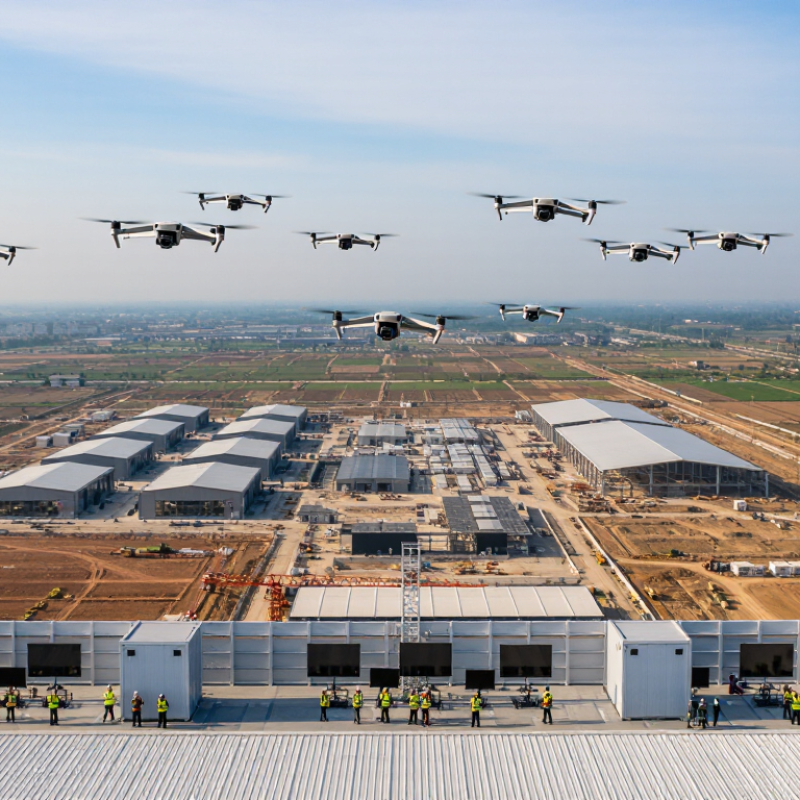
Before choosing swarm drones for commercial use, define the job in measurable terms. Is the task mapping crop rows, inspecting a roof, or counting inventory across a large site? Set the required area, image detail, completion time, and acceptable data gaps. A roof inspection may need close, repeatable images, while a broad field survey values coverage and consistent positioning. Don’t buy capacity you cannot use. Name the people who will review the results and act on them; otherwise, extra data can simply create more work.
The operating environment changes the choice. Record obstacles such as power lines, cranes, trees, and narrow launch zones. Check wind, rain, temperature, positioning signal availability, radio interference, and nearby people. Buildings can block signals, while reflective glass may complicate sensing. Plan safe separation, clear abort procedures, and a supervised landing area. Confirm local aviation, site-access, and privacy requirements before a trial. A map helps, but a walk-through often reveals details it misses. Expect revisions; the first site visit may expose an assumption you overlooked.
Tips: Run a small pilot at the real site. Log flight time, missed coverage, image quality, battery reserve, and operator workload. Change one setting at a time.

Choose swarm size from the task, not the aircraft count a supplier advertises. For a roof inspection, three drones may cover separate façades while one operator monitors overlap and battery levels. Start small. Add aircraft only when measured coverage improves without crowding the control interface. The FAA’s 2024 UAS By the Numbers report records more than 1.7 million registered drones in the United States; that broad fleet figure is not a swarm benchmark, but it shows why dependable traffic coordination matters.
Autonomy should handle routine spacing, route updates, and safe responses to low batteries or lost links. Keep human oversight clear. Test whether one aircraft can pause or return without disrupting the rest. Coordination needs more than a shared map: check position-update frequency, communication range, collision avoidance, and graceful behavior when one unit drops offline. In a warehouse, a delayed update can send two aircraft toward the same narrow aisle.
PwC’s 2016 Clarity from Above report forecast $127.3 billion in potential value from drone-powered solutions across industries by 2020; it is a historical forecast, not a current market measurement. Use task-specific trials instead. Record completed coverage, operator interventions, near-conflicts, and battery reserve across several flights. Imperfect data is still useful. A small pilot may expose weak coordination sooner than a polished demonstration.
Compare how well each application typically aligns with swarm size, autonomy, and coordination requirements.
Scores are illustrative planning ratings on a 1–5 scale, not measured industry benchmarks. Higher scores indicate greater importance of that capability for the application. Validate fleet size, operating rules, communications coverage, and human oversight requirements for your specific operation.
When choosing swarm drones for commercial work, treat compliance as a system requirement, not a box on a sales sheet. The FAA’s UAS-by-the-Numbers data reported more than 800,000 registered drones in the United States in 2023, showing how crowded operations have become. Check each aircraft’s Remote ID capability, geofencing, obstacle sensing, and lost-link response. Ask for test records, not just feature claims. In the United States, review applicable Part 107 limits and required waivers; rules differ elsewhere. A swarm may need approvals that a single-drone job does not.
Tips: Test the fail-safe on a closed site. Confirm that lost-link behavior is predictable, the return path avoids people, and one operator can identify every aircraft. Keep logs of firmware versions, battery health, and preflight checks. Small gaps matter.
Request the operator manual, safety case, maintenance schedule, and evidence of regulatory conformity before purchase. NIST’s work on UAS performance testing highlights measurable capabilities such as navigation accuracy and communications reliability; use documented test results to compare systems. Check how the fleet behaves when a battery drops below its limit or a radio link becomes unstable. Does it land, hold position, or follow a preset route? These choices need to fit the worksite and local rules. Paperwork can look complete while field procedures remain unclear, so run a supervised trial with realistic obstacles and a written emergency plan.
| How to Choose Swarm Drones for Commercial Use? - Check Safety Features and Regulatory Compliance | |||
|---|---|---|---|
| Evaluation Dimension | What to Check | Why It Matters for Commercial Use | Evidence to Request or Review |
| Regulatory operating category | Confirm which rules apply in every country and for each planned operation, including flight location, altitude, aircraft weight, and whether the operation is within visual line of sight. | Commercial permission depends on the operation, not simply on the aircraft being described as a “swarm” system. | Written compliance assessment, operating limits, and any required authorizations, waivers, or declarations. |
| Multiple-aircraft operation | Check whether one pilot may operate the planned number of aircraft under the applicable rules. In the United States, FAA Part 107 generally prohibits one remote pilot from operating multiple small unmanned aircraft at the same time unless an FAA waiver authorizes it. | A coordinated fleet may require a different operating plan or specific regulatory approval than a single-drone mission. | Applicable waiver or authorization, approved procedures, and a clear allocation of pilot and observer responsibilities. |
| Remote identification | Verify that each aircraft meets the remote-identification rules that apply to its registration, operating category, and location. In the United States, most drones that must be registered must comply with Remote ID unless an applicable exception, such as operation in an FAA-Recognized Identification Area, applies. | Identification requirements can apply to individual aircraft in a fleet and may affect where and how they can fly. | Applicable declaration or compliance documentation, aircraft configuration details, and a successful preflight Remote ID check. |
| Detect-and-avoid capability | Assess how the system detects and responds to other aircraft, people, obstacles, and other hazards. Check sensor limitations, detection range, blind spots, and performance in the intended environment. | Multiple aircraft increase the importance of preventing collisions within the fleet and with external hazards. | Test results, documented limitations, risk assessment, and procedures for situations the sensors cannot reliably detect. |
| Geofencing and altitude limits | Look for configurable exclusion zones, mission boundaries, altitude limits, and safeguards against entering restricted or prohibited airspace. | Automated boundaries can reduce accidental incursions but do not replace airspace checks or required approvals. | Demonstration of boundary controls, map and data update process, and documented pilot checks before launch. |
| Command-and-control link | Review link range, interference handling, encryption, connection monitoring, and whether each aircraft can be monitored independently. | Reliable communications help operators detect problems early and maintain control of the fleet. | Link performance test results, cybersecurity documentation, and a plan for radio interference or loss of connection. |
| Lost-link and emergency behavior | Confirm what each aircraft does after communication loss, navigation failure, low battery, or an emergency-stop command. Check that behavior is configurable for the site and mission. | Predictable individual aircraft responses reduce the chance that one fault creates hazards for the rest of the fleet. | Tested contingency procedures, emergency-response demonstrations, and records of fault-injection or scenario testing. |
| Fleet coordination and separation | Check how the system assigns aircraft, avoids conflicts, manages formation changes, and prevents unintended duplicate commands or simultaneous landing conflicts. | Coordination errors can cause midair collisions, mission failures, or hazards to people and property. | Fleet-level test reports, collision-avoidance logic description, and procedures for adding or removing aircraft during a mission. |
| Battery and power monitoring | Review per-aircraft battery status, temperature alerts, reserve thresholds, charging controls, and the process for removing a weak battery from a mission. | Battery faults can shorten flight time or cause an aircraft to land unexpectedly while the rest of the fleet is operating. | Battery health records, maintenance intervals, charging guidance, and low-battery contingency procedures. |
| Operator workload and training | Assess the number of aircraft a trained crew can supervise safely, the quality of fleet status displays, and the training required for normal and emergency operations. | Automation does not remove the need for qualified, attentive personnel and clearly assigned responsibilities. | Training syllabus, competency records, crew-role descriptions, and results from realistic practice missions. |
| Flight logging and incident review | Check whether the system records aircraft identity, location, time, commands, alerts, link status, and system faults for each aircraft. | Accurate records support maintenance, incident investigation, operational reviews, and applicable recordkeeping duties. | Sample exportable logs, retention settings, time synchronization details, and data-access controls. |
| Payload and operational risk | Verify payload weight, attachment security, release mechanisms, and whether the payload changes the aircraft’s operating limits or creates additional hazards. | Payloads can affect flight performance and may trigger additional safety, privacy, or regulatory considerations. | Payload specifications, secure-installation checks, updated flight calculations, and a mission-specific risk assessment. |
| European Union operating category | Determine whether the planned flight fits the Open category or requires the Specific category or another applicable pathway. Operations outside Open-category limits may require an operational authorization or another permitted route, depending on the circumstances. | Category, aircraft class, and operation-specific conditions determine the applicable requirements; a fleet operation should be assessed as actually planned. | Category assessment, applicable authorization or declaration, and checks for relevant pilot, aircraft, and remote-identification requirements. |
| Requirements vary by jurisdiction and mission. Confirm current rules with the relevant aviation authority and obtain qualified operational or legal advice before commercial deployment. | |||
Compare Costs, Reliability, and Vendor Support
Compare the full operating cost, not just the purchase price. Include batteries, charging equipment, software subscriptions, operator training, spare units, and scheduled maintenance. Ask vendors for a three-year cost estimate, then test its assumptions against your flight schedule. A low quote may exclude replacement parts or technical support. Small details matter. For example, batteries that lose capacity over repeated cycles can reduce daily coverage and add labor.
Track cost per completed mission, not cost per aircraft. This makes different fleet sizes easier to compare.
Reliability needs evidence from conditions similar to your site. Request availability records, failure definitions, and maintenance intervals, then run a supervised pilot with realistic payloads and operating conditions. Record aborted flights, recovery time, and how often the fleet needs manual intervention.
Demos can mislead. Vendor support is part of reliability: confirm response hours, spare-part lead times, software update policies, and who handles troubleshooting. Get these details in writing.
A spreadsheet can still mislead if it assumes perfect uptime; buyers may overlook downtime caused by training or network gaps. Leave room for that uncertainty when comparing offers.
A pilot should test the whole swarm in the place where it will work, not just in an open field. The FAA’s 2023 registration data recorded more than 350,000 commercial drones in the United States, showing how quickly operational needs can scale. A small trial can expose problems before a fleet grows: overlapping routes, weak radio coverage, or batteries that drain faster in cold air.
Set measurable targets before launch. Track mission completion rate, location accuracy, collision-avoidance events, communication dropouts, and time needed to replace a battery. NIST’s work on small UAS test methods stresses repeatable, measurable evaluations; use the same route, payload, and weather limits across trial runs. Keep a human observer near the launch area, and record every manual intervention. The spreadsheet may be less exciting than the flight.
Test ordinary disruptions, too. A parked truck can block a signal; a gust can scatter formation spacing. Run a single-drone baseline, then add aircraft gradually. Compare results with your targets, and pause expansion if performance slips. One caveat: a tidy pilot site may hide real-world clutter. Include a second location or shift, even if it complicates the schedule. That friction is useful. It shows whether the system is dependable, or merely lucky.